Spoiler Alert: turn back if you’ve never read/watched Mob Psycho 100 so you can experience its greatness for yourself!
Shonen manga/anime is inarguably the genre that I consumed the most in my youth. As the name implies, it’s mainly targeted towards boys/younger men.
Regardless, the genre of a manga does not and should not dictate whether the consumer should enjoy it, and at the end of the day shonen manga (and anime) are generously consumed by people of all ages and backgrounds. I myself was twelve years old when I first started watching Katekyo Hitman Reborn!, and would continue watching shonen anime to this day.
Of course, after many, I have come to notice some tropes and cliches in particular to this genre and in stories in general. And while I do not necessarily think tropes are bad, as what really matters is the execution, I must say that it is refreshing when a series tries to subvert them.
For me, Mob Psycho 100 is that series.
mob psycho 100
Mob Psycho 100, written and illustrated by ONE who, at this time, was known for his work with One Punch Man. It was first serialized as a web manga in 2012, and in 2016 it would later be developed into an anime by Studio Bones.
The plot surrounds a middle school boy nicknamed Mob who is an “esper” (someone with ‘psychic’ abilities who can see and exorcize spirits) trying to better restrain his overwhelming psychic powers and, more importantly, deal with the pains of growing up and wanting to be popular. He works for a con artist, Reigen, who runs an exorcism agency despite not having any psychic powers himself.
Both Mob and Reigen interestingly seem to be trying to find his place in the world, and throughout the three seasons shows a lot of growth himself. Notably, a lot of this growth does not come in the ways that you might expect from a shonen series, and from manga/anime no less.
As such, I will be reviewing the plot and character trope subversions present in this series.
1. plot trope subversion
Mob joins the Body Improvement Club
Let’s talk about some of the ways Mob Psycho 100 applies plot subversion.
In the early chapters, the Telepathy Club at Salt Middle School is on the verge of disbanding due to not having enough members. As a result, they had tried recruiting Mob into their group.
This is a common trope not just in coming-of-age, school-centred series, but other media. There’s a TV Tropes page for it called Club Stub. A couple examples listed in this page are K-ON! and CLANNAD.
On the surface, joining the Telepathy Club sounds promising. Since Mob is an esper, someone with psychic powers, joining this club seems right up his alley, right?
Wrong.

Instead, Mob decides to join the Body Improvement Club, with the goal of self-improvement. He recognizes that joining the Telepathy Club would not help him further his goals. Not only was the Telepathy Club not actually about telepathy, but it turned out to be a front for a group of friends to have a room to fool around in after school. And while Mob could have arguably still gone with them in the hopes of building friendships with them, he evidently did not think he would grow much with them.
This decision worked out for Mob pretty well. Not only did he develop friendships with members of the Body Improvement Club, he still was able to develop and maintain friendships with the former Telepathy Club.
Reigen tells Mob to run away
Another subversion present in MP100 occurs when Reigen tells Mob that he should run away from a fight.
Normally, in anime/manga, as well as in other media, adult figures are… well, often difficult to trust, at least in terms of being able to fully protect the youthful protagonists—of course, according to the plot, this isn’t always their fault.
In Naruto, for instance, the protagonists and their cohort function more like child soldiers due to war, so it is expected that they are often put into mortal danger, especially when their mentor figures are unable to protect them.
In My Hero Academia, the teenage students of UA somehow always find themselves entangled with fighting villains, despite the fact that there were adult heroes who probably should have been more than capable of handling the villains. Of course, this could be a commentary on how children and young people have to make up for the shortcomings of their elders, or something along those lines.
Regardless, the fate of the world always seems to fall on the shoulders of children—and there is almost always a scene where, when odds are stacked against the adult figures in a mortal situation, they rely on children to fight back. This usually results in some kind of power-up for the protagonists born from pressure, or if the protagonist already had the power, they are expected to unleash it.
In this instance, Mob is being pressured to fight one of the antagonists. But rather than Reigen egging Mob to fight back harder, to unleash the full capacity of his power and attack, possibly murder the antagonist, he tells Mob to run away:
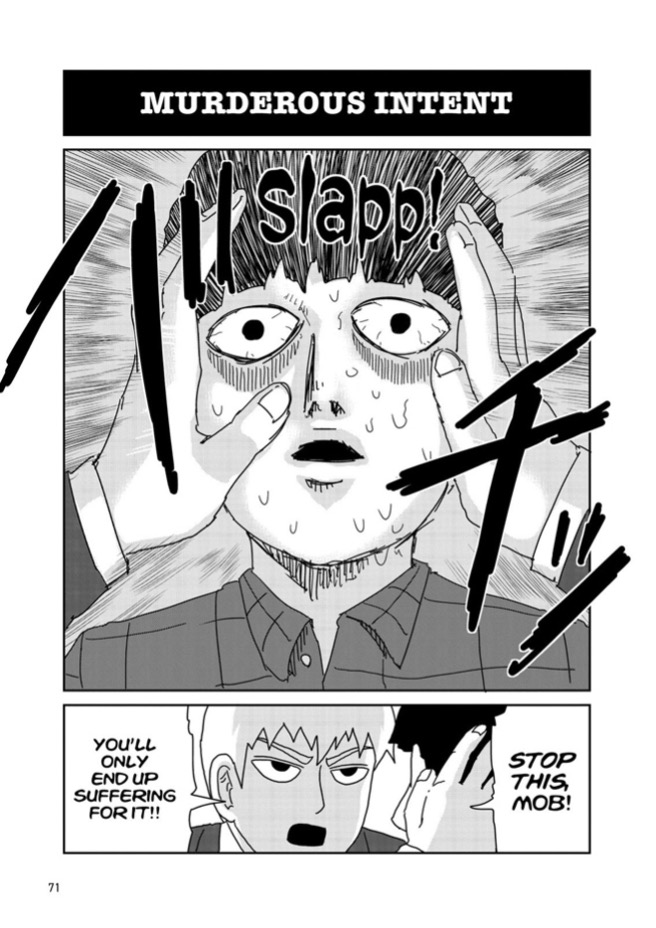
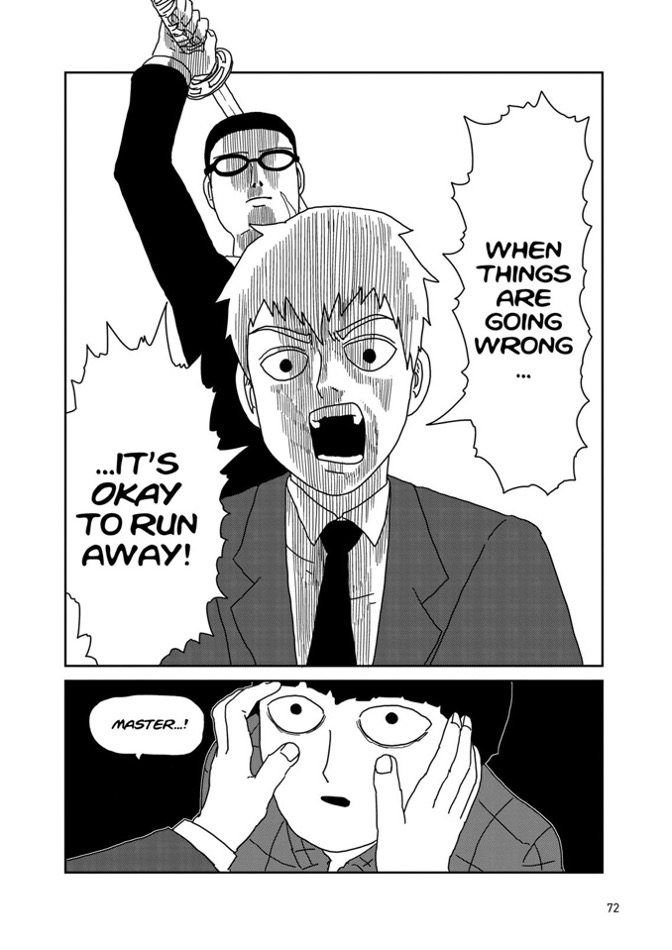

Of course, as we see in these panels, Reigen seems to get mortally injured. At this point, we think that Mob will become furious and succumb to his anger.
But this doesn’t actually happen, once again subverting our expectations.
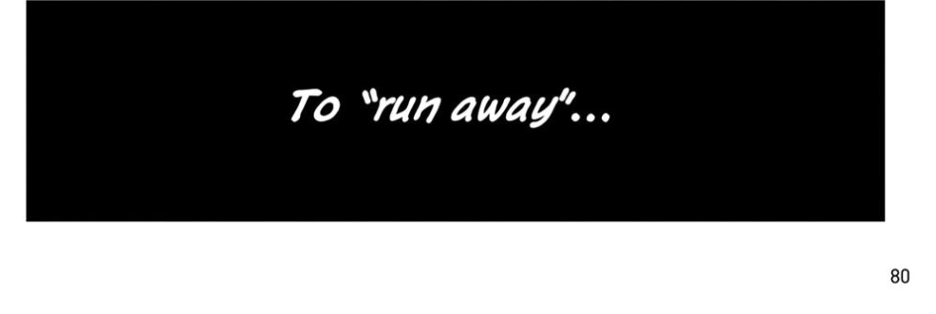
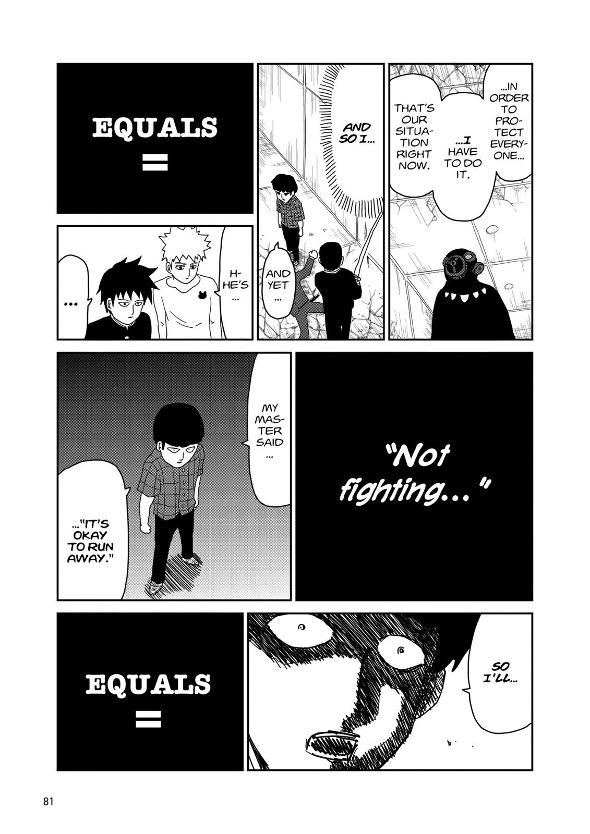
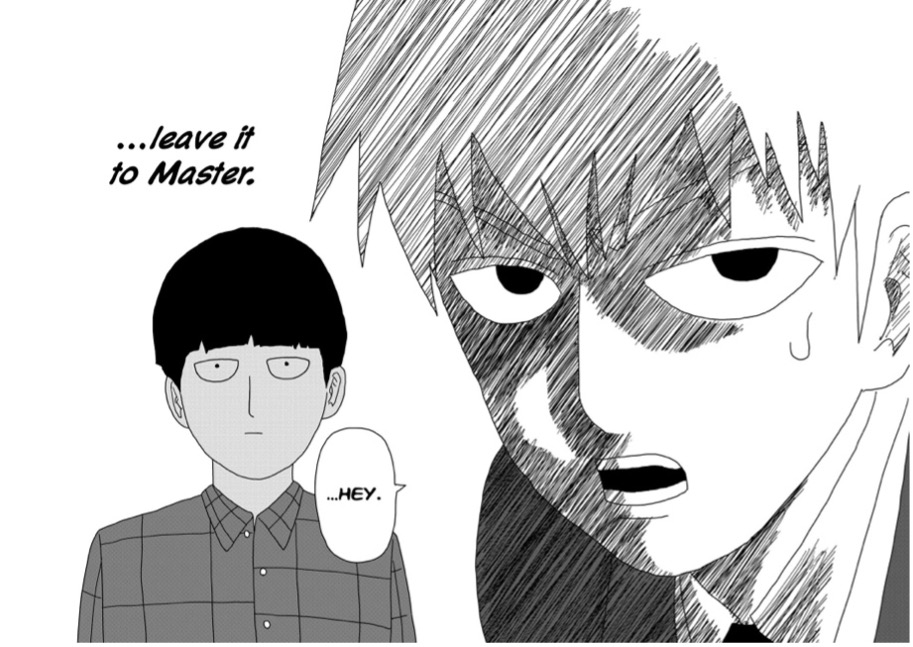
“Those with power must choose to fight. The thought of that responsibility made Mob’s bridge collapse. But sometimes, one’s heart can find the resolution it needs just by getting a helping hand. As a result, all of Mob’s energy was temporarily tossed over to Reigen. In essence, he’d successfully run away and was feeling calm and refreshed. All that was left in his heart was gratitude.”
Instead, Reigen somehow is able to get up. We later find out that this is because Mob unintentionally transferred his powers to Reigen, grateful for no longer feeling pressured to fight.
2. character trope subversion
Reigen: The Con Man
At this point, I’ve talked a lot about Reigen. And although I’ve praised him, I’m not saying that Reigen is perfect, especially as an adult figure. Hiring a child to do his exorcism work for little pay is definitely not amazing.
His profession is also dubious. He fakes being a psychic but still ‘performs’ exorcisms in exchange for monetary compensation, fitting the TV Trope, “The Con Man”. The only times actual exorcisms get performed are when Mob or another psychic character is present in the scene.
Still, Reigen surpasses our expectations.
For one, even though he scams people who come to him for exorcism services, he still tries to help them.
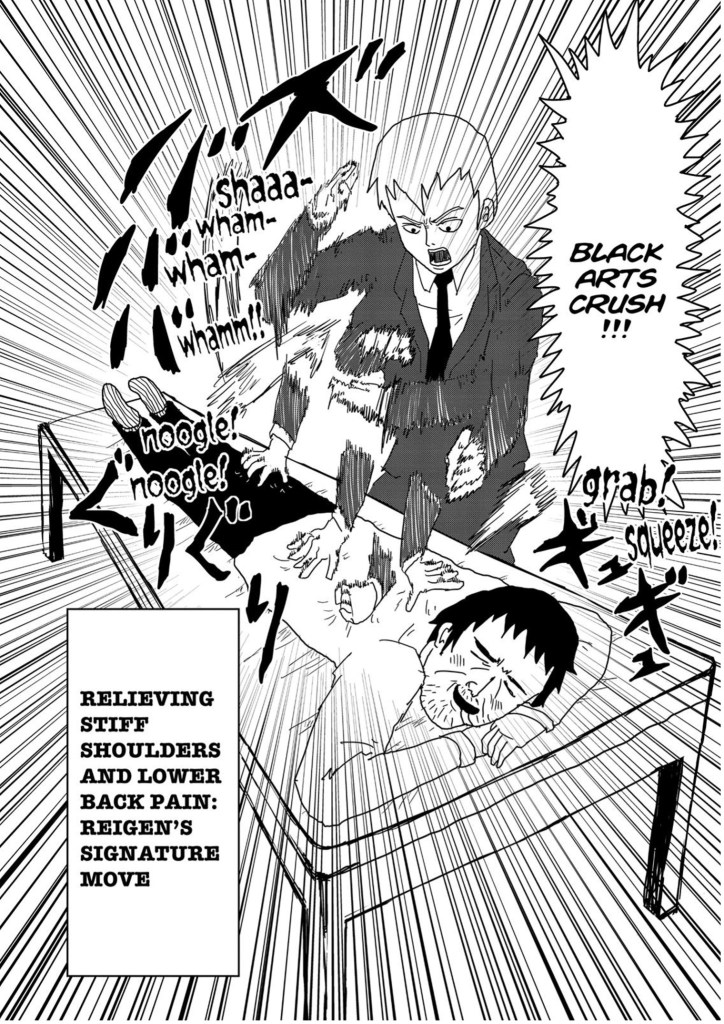
Often, people come to Reigen for exorcisms even though they are not necessarily haunted. So, Reigen pretends to exorcise them, when in reality he’s fixing the actual cause of the problem (in this case, his client’s back issues).
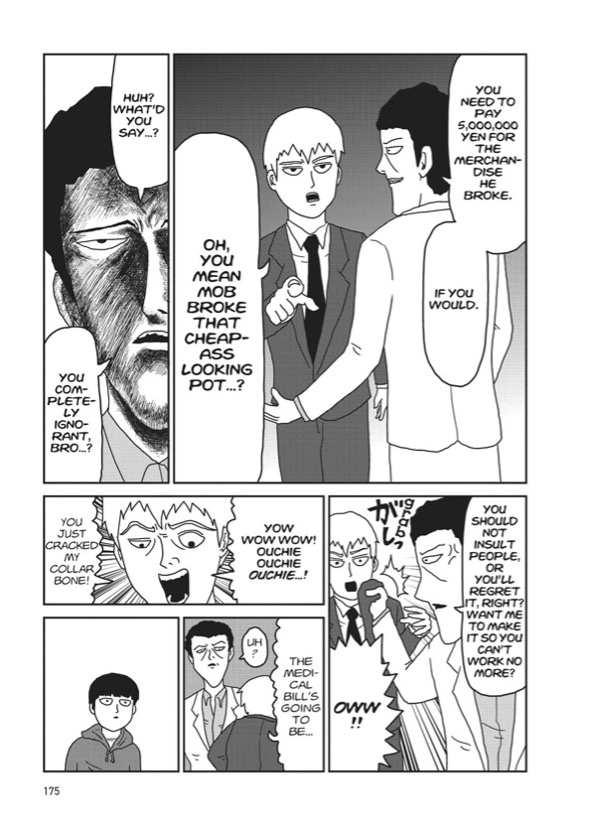
Furthermore, as already hinted by the first section of this post, Reigen cares a lot about Mob. Despite exploiting Mob’s psychic abilities, he doesn’t want him to get hurt, and he actively does what he can to get Mob out of danger in situations even outside of mortal peril. For instance, Reigen saves Mob from other scam artists who try exploiting him, accusing him of breaking a 5,000,000 pot.

Moreover, we see more of Reigen’s true care for Mob upon their first actual interaction with each other. In a flashback, we see them meet for the first time.
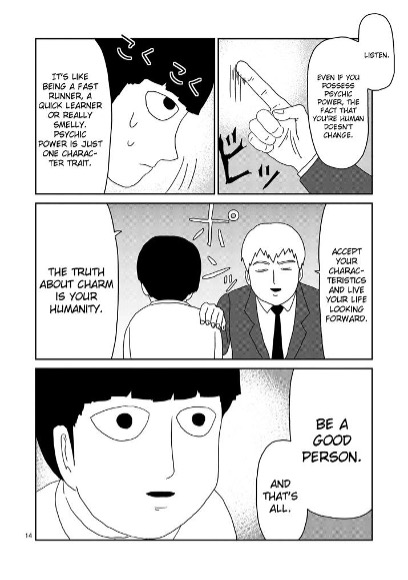
Despite thinking that Mob was messing with him about having psychic powers, he gives Mob kind advice, thoughtful advice—and this advice sticks to Mob for a long time, essentially helping Mob build his moral compass and making sure that he doesn’t use his powers for evil like many other espers in the series despite his great power.
Mob/Shigeo: The Skilled, but Naive Protagonist
Mob himself also subverts quite a few shonen tropes. As a protagonist, he starts off already quite powerful. Rather than actively trying to become powerful and wanting to become something that initially seems out of reach (e.g. the Hokage, the Number One Hero, the Pirate King), he’s trying to better control and restrain his abilities. His only real desire is to become a more popular (and to confess to the girl he likes). His desires are ultimately fairly mundane.
Regardless, given this description, Mob does seem to fit the TV Trope called “Skilled, but Naïve”.
Even so, Mob has a great, sincere, and mature understanding of the people that he cares about. While he never outwardly shows his awareness that Reigen is a con artist up until Reigen gets exposed in the Separate Ways Arc, the ending seems to imply that he was aware, accepting Reigen for who he is regardless because be ultimately believes that Reigen is a “good person.” This is likely the reason why Mob didn’t mind being lied to.
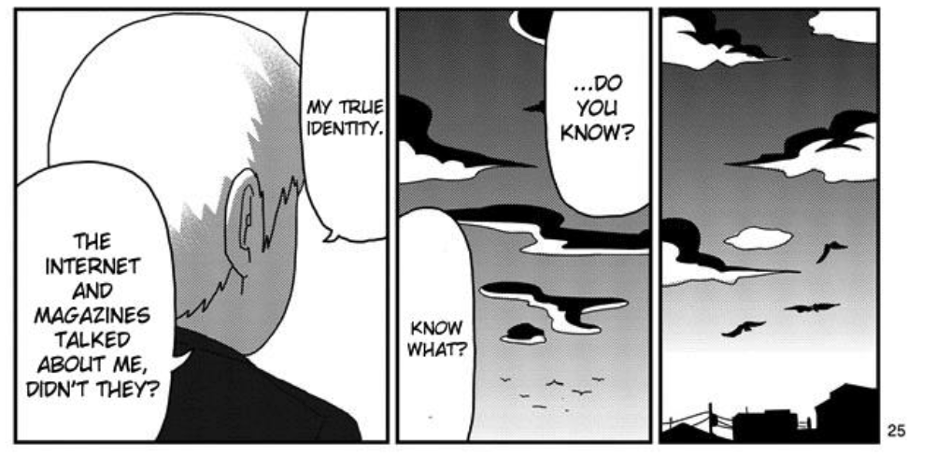
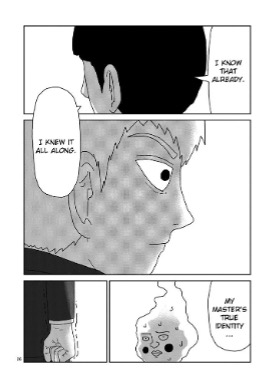
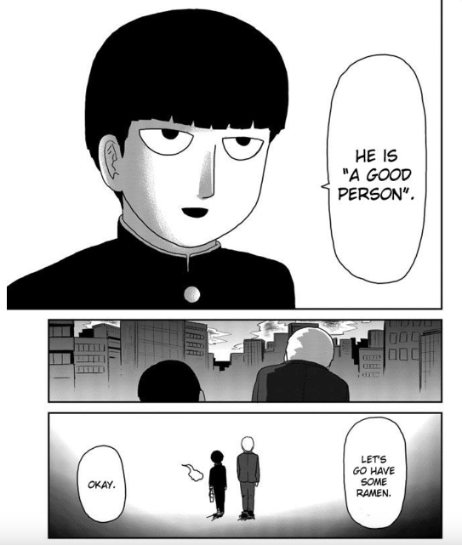
Mob’s knowledge that Reigen does not have psychic powers is further confirmed in the ???% Arc and final season. On his way to confess to his crush, Tsubomi, Mob saves a child from getting hit by a car, getting injured in the process. The scary, eldritch-like ???% side of him takes over, going through with his original desire to confess to Tsubomi but causing destruction along the way due to his overwhelmingly powerful psychic powers.
In an attempt to get ???% under control, Reigen confronts Mob, despite the danger.
Once he’s able to get to Mob, he then outwardly confesses his lies, wanting to show him that everyone has two sides to them, helping Mob accept himself for who he is.
Ultimately, Mob/???% does not push Reigen away, yell at him, or try to hurt him in a fit of rage like we would have expected, especially since ???% was in control. Rather, he actually calms down, reigning in his psychic powers. He seems surprised that Reigen is telling him about it at all. This is definitely not the reaction of someone who had been told negatively life-changing news, and it’s refreshing to see a possible ‘misunderstanding’ not end in more unnecessary drama.
Moreover, the fact that Reigen’s words were able to come through to Mob even though the cynical ???% side of him was in control is telling of Mob’s sincere faith and understanding in Reigen and the people he cares for.
to reiterate, tropes are NOT inherently bad
Although Mob Psycho 100 has subverted many common tropes, it certainly still makes use of quite a few of them, as any story would. Of course, this is far from a bad thing. Story and character tropes are what make neat subversions unique in the first place, no matter the genre. And as someone who enjoys writing fiction, I adore ONE’s ability to mould these tropes at his will to present a fun, engaging story.
 ysawrites